How AI co-workers give companies specialised expertise without hiring

Imagine having an always-on team of specialists that plugs straight into your business without months of recruiting, onboarding and training. For leaders of small and medium sized enterprises, that scenario is no longer wishful thinking. AI co-workers provide specialised expertise without hiring in the traditional sense, so you can scale the business without recruiting, reduce hiring costs with AI and keep operational efficiency high from day one.
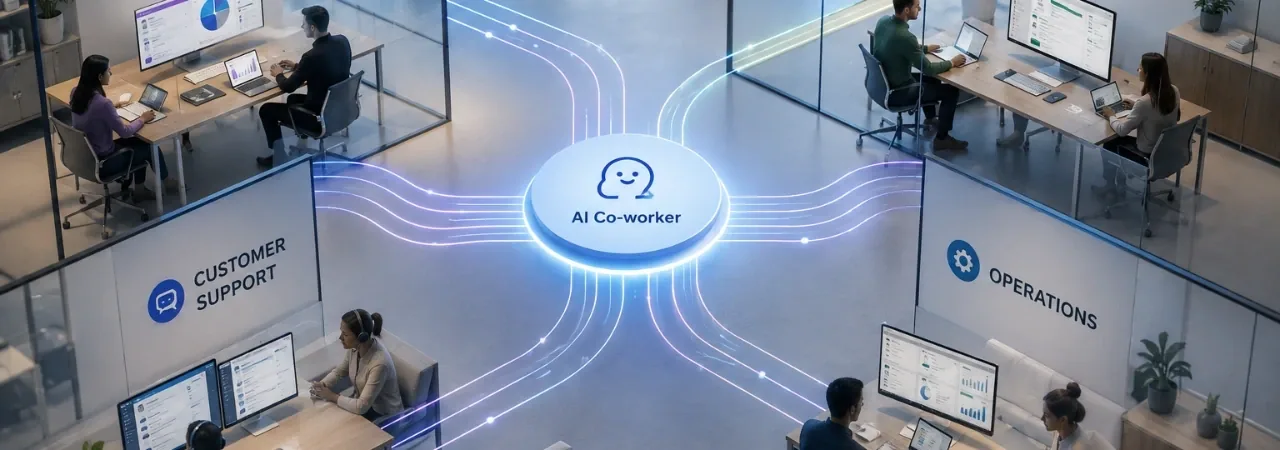
Across marketing, sales and customer support, these AI workforce solutions act like reliable colleagues who know your brand, execute repeatable work to a defined standard and escalate only when human judgement is needed. The payoff is clear. You build capacity and speed without inflating headcount, while your teams focus on strategic work that actually moves the numbers.
Ready to bring AI into daily operations without disrupting your people? Read how to integrate AI into existing business processes without disrupting teams to get started safely.
The hidden cost of chasing specialised talent
Hiring a seasoned marketer, a sales operations expert or a customer support lead can take months and lock significant budget before you see any value. Meanwhile, competitors using AI co-workers are closing the gap with consistent execution and round the clock coverage.
Why traditional recruiting often underdelivers
Time to hire for specialist roles easily stretches from three to six months. Advertisements, interviews, offers, notice periods and onboarding all add friction and uncertainty. By the time a new employee reaches full productivity, priorities may have shifted and the original business case can weaken.
There is also the hard cost of hiring itself. Industry sources note that agency fees frequently range from 15 to 20 percent of the candidate’s annual gross salary, with additional internal costs to source, screen and onboard. See a concise overview here: cost per hire benchmarks and drivers.
The real costs beyond salary
Salary is only the visible part of the iceberg. When you tally the total employment cost, department automation tools and AI employees for SMEs begin to look like a pragmatic alternative that de-risks capacity planning:
- Onboarding and integration: three to six months before full productivity
- Continuous training: typically five to ten percent of annual salary
- Benefits and overheads: healthcare, meal allowances, bonuses and tools often add 25 to 40 percent
- Management time: hours diverted from strategy to supervision and approvals
- Turnover risk: replacement costs can reach a large share of annual salary when hires do not work out
Operational efficiency AI flips this equation. You can stand up a dependable capability quickly, pay only for the capacity you need and maintain consistent quality through clear instructions, governance and human oversight.

What AI co-workers actually do for your business
AI co-workers are not just chatbots. They are AI workforce solutions that execute end to end tasks repeatedly and reliably, using your playbooks, data and guardrails. They provide specialised expertise without hiring, operate 24 hours a day and escalate thoughtfully when a human decision is required.
Beyond scripted answers, towards real execution
Think of an AI marketing automation colleague that drafts search optimised articles, schedules social posts, assembles newsletters and ships on time every week. Picture an AI sales assistant that qualifies inbound leads, prioritises follow ups based on behaviour and updates your customer relationship management system without reminders. In customer care, an AI customer support agent can resolve common issues, enrich your knowledge base and pass complex cases to the right expert with full context.
Independent analysts highlight how customer self service, agent enablement and workflow automation reduce effort and improve resolution times. See Gartner on customer service AI use cases for the most common patterns and where they drive value today.
How they learn your brand and processes
You do not need months of training to make progress. Department automation tools can be configured in days. They absorb brand tone, policies and goals by ingesting your guidelines, past messages and process documents. With structured feedback and light human review, they adapt quickly, raising quality week after week. This is business productivity automation in practice, helping you scale the business without recruiting while preserving a consistent voice.

Three departments transformed by AI co-workers
When done well, AI employees for SMEs enhance the way teams work, not just the speed at which tasks are completed. Here is what that looks like in practice.
Marketing: consistent content and campaign execution
AI marketing automation can own a repeatable editorial rhythm and support your go to market calendar. Typical responsibilities include:
- Producing search ready blog content and long form resources aligned to your positioning
- Planning and publishing social updates across channels with brand safe copy
- Designing and sending personalised email campaigns, from segmentation to scheduling
- Tracking performance and surfacing insights with clear, human readable reports
- Running controlled A or B tests to improve conversion on landing pages and emails
Sales: faster qualification and reliable follow up
An AI sales assistant can evaluate lead fit, assign scores and notify account owners without adding manual steps. Every touchpoint is logged to customer relationship management for a clean pipeline. Research from well known sales platforms indicates that automation shortens response times and lifts win rates when teams combine it with clear rules of engagement. Personalised nudges then go out at the right moment, based on the buyer’s signals rather than guesswork.
Support: resolution at speed without growing headcount
An AI customer support agent triages requests by intent and urgency, offers accurate self service answers and drafts high quality responses for human review when needed. Routine issues get closed quickly and complex cases reach the right specialist with full history attached. The net effect is shorter time to resolution and a better experience for customers and agents alike.

How to start without disrupting your team
You do not need a big bang programme. A simple, low risk path lets you reduce hiring costs with AI while keeping your people confident and involved.
Start small with one use case
Choose a single, repetitive task with high business value. In marketing, begin with weekly newsletter assembly and scheduling. In sales, apply an AI sales assistant to initial lead qualification only. This focused start helps your team build trust in the approach and prevents overload.
Experienced advisors recommend phased adoption, with clear goals and governance from the outset. For practical guidance on building the human and organisational side of adoption, see McKinsey’s strategies for sustainable AI adoption.
Measure, learn and then expand
Define success metrics before you launch. Time saved per task is often the most direct signal of operational efficiency AI. Also assess quality: does the output meet your brand standards and move key numbers such as conversion or response time? Gather explicit feedback from your team and improve your prompts, guardrails and workflows accordingly.
After four to six weeks, you will have data to support expansion into adjacent tasks or departments. If you prefer a structured method to scale with confidence, use the complete AI transformation roadmap for companies as a reference for prioritisation, governance and change management.

AI co-workers have changed access to specialised expertise without hiring for growing companies. From AI marketing automation to an AI customer support agent, these AI workforce solutions let you scale the business without recruiting while keeping costs predictable and quality consistent. The companies that combine human judgment with business productivity automation will build a durable edge. The real question is not if you will adopt AI employees for SMEs, but where you will begin.
See what this looks like in your context
Explore AI co-workers and map the roles that fit your goals.
Frequently asked questions
Do AI co-workers replace human employees?
No. AI co-workers complement your teams rather than replace them. They take care of repetitive, well defined work and first line execution, so your people can focus on strategy, creativity and complex stakeholder relationships. Think of them as reliable assistants that extend your capacity and improve consistency.
How long does it take to deploy an AI co-worker?
Typical deployments run from a few days to a few weeks, depending on task complexity and the quality of your existing guidelines and data. That is significantly faster than traditional recruiting and onboarding, and it makes it easier to experiment, learn and expand with evidence rather than assumptions.
What happens if an AI co-worker makes a mistake?
Critical actions should sit behind human review steps, with clear rules on when to escalate. Each correction becomes a training signal that improves future performance. Over time, this feedback loop reduces errors and raises confidence, while governance ensures you maintain brand quality and compliance.
Help your colleagues discover this article.
Related articles