Will AI replace marketing agencies or make them more valuable
The marketing landscape stands at a pivotal crossroads as artificial intelligence reshapes every aspect of digital strategy and client engagement. AI marketing agencies are no longer a futuristic concept but a present reality, with intelligent marketing automation tools executing campaigns that once required entire teams. The question pressing agency leaders and marketing professionals is not whether AI will influence their work, but whether it signals their obsolescence or a step change in their strategic value.
Marketing agency AI integration has created a paradox that deserves immediate attention. While AI-powered agency services can generate content in seconds, analyze consumer behavior patterns instantly, and optimize campaigns in real time, clients still expect the strategic thinking and creative innovation that define exceptional outcomes. Traditional agencies feel pressure as automation threatens to commoditize core services, yet the complexity of deploying and governing these systems creates an opening for those who can bridge the technology gap. The future of marketing agencies hinges on understanding this balance between technological capability and human expertise, and it will also reshape the future of marketing across every channel.
This article examines how AI agency transformation is reshaping the industry and asks a direct question: does artificial intelligence threaten the agency model or act as a catalyst that makes agencies more indispensable than ever?
Leading B2B teams move faster with smart AI solutions that blend automation with strategy. Explore what is possible for your organization.
The current state of AI in marketing agencies
Marketing agencies in 2025 are seeing a structural shift as AI integration reaches every core function. What once required hours of manual analysis now happens in seconds, with intelligent marketing automation handling data interpretation, content generation, campaign optimization, and customer segmentation at previously unimaginable scale. In parallel, governance and quality control have become board-level conversations, because the speed of automation must be matched by standards that protect brand and compliance.
Leading AI marketing agencies deploy toolkits that extend beyond basic automation. Predictive analytics forecast performance before launch, personalization algorithms tailor messaging at the individual level across thousands of touchpoints, and automated reporting surfaces insights without human intervention. Data pipelines ingest signals from CRM, advertising platforms, and product analytics, while language models and vision models create text and visuals that are then reviewed through quality gates to maintain brand voice. The technology exists to transform how agencies operate end to end.
Yet implementation quality varies widely. Top-performing teams approach marketing agency AI integration strategically, embedding AI-powered agency services within operating frameworks that preserve human oversight and creative judgment. These organizations use artificial intelligence as an amplifier of human capability rather than a replacement for strategic thinking. They invest in model selection, prompt engineering, and measurement plans that link outputs to commercial goals, not just content volume.
Conversely, agencies that adopt superficial automation without reimagining processes learn the hard way that technology alone delivers limited advantage. Simply layering AI marketing tools and platforms onto outdated workflows creates new inefficiency, content sprawl, and governance risk.
AI tools reshaping agency operations
Machine learning platforms continuously test campaign variations, identifying winning combinations faster than any human team could. Natural language processing now delivers dozens of headlines, emails, and ad copy variations within minutes, with human editors curating the best options. Computer vision helps assemble on-brand visuals at speed, while media platforms auto-adjust bids based on signal strength and predicted propensity to convert.
Predictive algorithms have changed budget allocation, shifting resources across channels in real time based on performance signals and market conditions. These AI consultant marketing capabilities enable agencies to maximize return on investment dynamically, replacing static, monthly planning cycles with responsive systems that act in minutes.
The automation-strategy balance
The most successful agencies have solved a critical equation: delegate repetitive tasks to AI and elevate human strategists to higher-value work. Data processing, performance monitoring, variant testing, and routine optimization now run autonomously through learning systems. Human specialists use the freed time to pressure test positioning, craft bold creative territories, and engage stakeholders to align marketing with revenue outcomes.
This shift lets strategists focus on complex problem solving, nuanced client relationships, and commercial innovation that machines cannot replicate. In practice, that looks like brand teams spending more hours in customer discovery and fewer in building slide after slide of reports. The future of marketing agencies depends on maintaining this equilibrium between automation efficiency and human judgment.

Why AI cannot fully replace marketing agencies
Despite the power of intelligent marketing automation, AI lacks the human dimensions that define effective partnerships. Strategy demands deep business context, nuanced industry expertise, and an understanding of competitive dynamics that a general model cannot authentically replicate. Even the most advanced system still works within patterns it has seen before, while markets frequently reward the novel and the unexpected.
Creative innovation requires emotional intelligence, cultural awareness, and the ability to tell stories that move people. While AI-powered agency services can generate countless variations of a message, they do not originate the kind of platform ideas that shift a category conversation or reframe a brand from the ground up. This does not mean AI is unhelpful, it means creative direction is still human-led.
Relationships also matter. Clients buy trust, not just outputs. They want a partner who listens, challenges assumptions, and navigates trade-offs with care. When market conditions shift or brand crises emerge, human marketing expertise and crisis management become irreplaceable. In a critical incident, your team needs a counselor who will read the room, align executives, and choose a course of action that protects reputation and revenue.
The irreplaceable human elements
Empathy, ethical judgment, and cultural sensitivity are uniquely human strengths that set agencies apart from tactical execution. AI marketing agencies that embrace this reality position themselves as strategic partners rather than commodity service providers. They use AI to inform decisions, not to drive them blindly.
The ability to navigate complex stakeholder dynamics, manage conflicting priorities, and build consensus across organizational silos remains human-centric work. The more technology saturates the market, the more clients prize the discernment and creative bravery that only experienced teams bring.
Strategic complexity AI cannot master
- Brand transformation and market repositioning require contextual insight that goes beyond pattern recognition
- Crisis navigation demands real-time judgment and stakeholder empathy under pressure
- Innovation strategy involves creative risk-taking that challenges conventional assumptions
- Long-term vision development requires adaptive thinking that anticipates cultural shifts
Consider a mid-market manufacturer facing sudden regulatory changes and supply chain delays. AI can forecast scenario impacts on demand, but it will not persuade distributors, coach spokespeople ahead of press briefings, or shape a new narrative that restores confidence. That is where seasoned strategists earn their mandate.

How AI makes marketing agencies more valuable
AI augmentation turns agencies from tactical executors into strategic partners that deliver outsized value. Rather than threatening relevance, intelligent marketing automation clears low-value tasks and amplifies human expertise. When AI-powered agency services handle data processing, performance monitoring, and routine optimization, specialists redirect their energy to high-impact strategy, creative platforms, and cross-functional alignment that drives growth.
Real-time performance optimization enables measurable improvements by testing continuously and refining budgets and creative at a pace that was not feasible manually. Campaigns evolve based on AI-driven marketing performance analytics, with models adjusting copy, offer, and audience thousands of times per day. That constant iteration compounds into material gains in conversion, efficiency, and revenue contribution.
Predictive analytics now provide forward-looking intelligence on category trends, customer behavior shifts, and likely performance trajectories. That means marketers can act before a drop-off occurs, not after. AI marketing agencies that work this way become advisors, not just executors, because they shape decisions earlier in the process when leverage is highest.
Enhanced client outcomes through automation
AI enables economically viable personalization at scale, tuning messaging to individual behaviors across thousands of touchpoints simultaneously. Continuous optimization runs in the background, testing variants and refining approaches while human leaders guide the core brand idea. Predictive performance modeling frequently outperforms manual approaches in both conversion rates and budget efficiency. In practice, marketing agency AI integration delivers tangible advantages through better targeting accuracy and more precise resource allocation that link directly to commercial goals.
Example: a business-to-business software company connected advertising data, CRM opportunity stages, and product usage signals. With automated creative testing and predictive budget shifts, it reduced cost per qualified opportunity by 19 percent and shortened sales cycle time by eight days within one quarter, while the brand team focused on a refreshed positioning for enterprise buyers.
Strategic capacity unlocked by AI
By automating analysis and routine optimization, agencies can focus on brand development, market positioning, and innovation initiatives. Hours once consumed by building reports now support workshops with customer-facing teams, structured experimentation plans, and executive decision-making. This elevation of work creates differentiation in crowded markets where tactical execution looks and feels similar across vendors.
Competitive advantages of AI-enabled agencies
Use AI to accelerate execution while preserving human judgment for creative direction, governance, and stakeholder alignment.
Agencies that adopt intelligent automation deliver faster execution cycles, deeper behavioral insights, and more accurate forecasting than teams relying on traditional methods. Transparent attribution models and clear measurement frameworks build confidence. Most importantly, they link activity to outcomes, speaking the language of pipeline, revenue, and margin rather than proxy metrics alone.

The emerging AI-augmented agency model
Forward-thinking agencies are building hybrid models that combine intelligent marketing automation with specialized human expertise. This integrated approach recasts AI marketing agencies as orchestrators, not just service providers. They select the right tools, design intelligent workflows, and convert algorithmic signals into clear business actions, all while maintaining creative coherence and brand safety.
The most successful teams invest in continuous AI training for strategists and creatives. They develop proprietary frameworks tailored to client needs rather than deploying generic setups. They also define escalation paths for human review and ethical checks for data usage. In short, they engineer a system where people and models work together by design.
Leading AI-powered agency services maintain dedicated AI consultant marketing specialists who bridge technology and strategy. These experts interpret complex patterns, recommend adjustments grounded in evidence, and ensure implementation methods follow sound principles that align with business objectives. The focus is not on tools for their own sake, but on outcomes that matter to leadership.
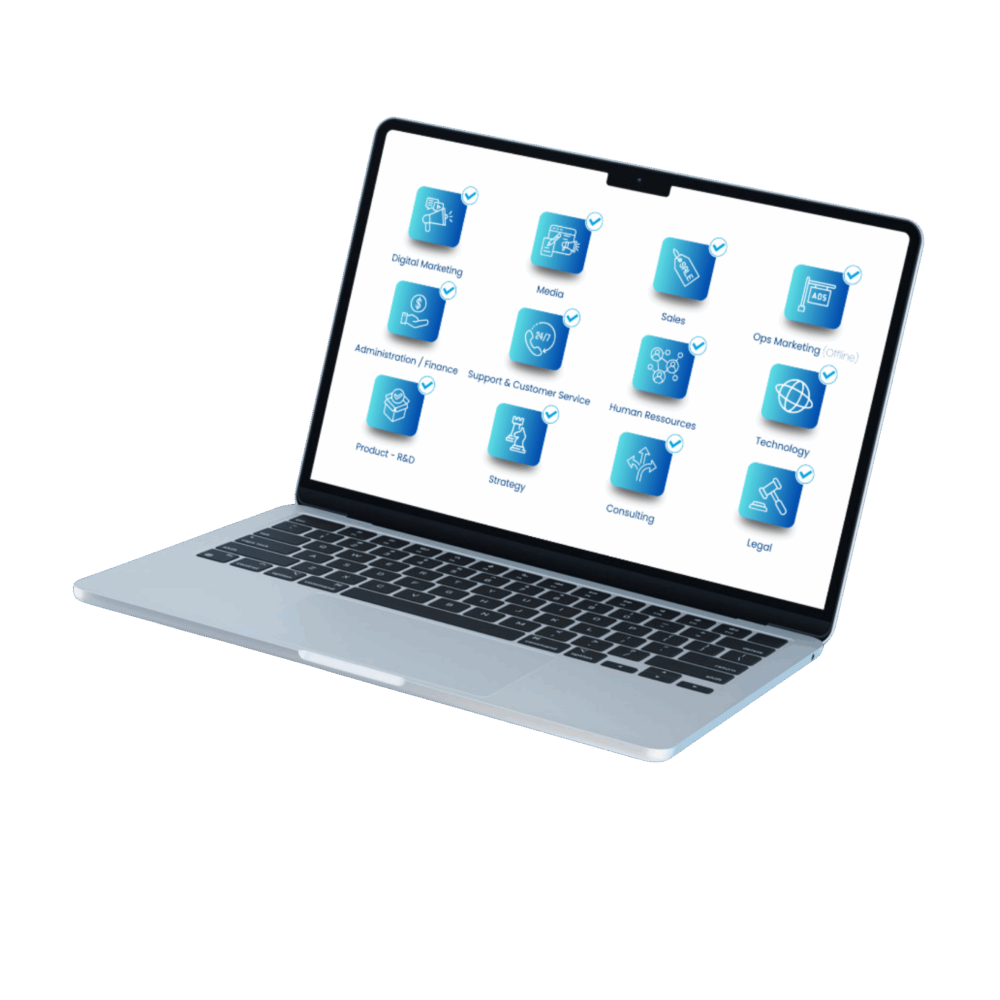
The AI-augmented agency model differentiates through implementation expertise, custom integration with client systems, and the ability to deploy intelligent agents across functions. Marketing agency AI integration extends beyond the marketing department to Sales, Support, and Human Resources, creating organization-wide gains rather than isolated improvements.
Consider a maturity model many teams follow: Stage one, automate reporting. Stage two, automate experimentation and media allocation. Stage three, integrate CRM and product analytics for closed-loop learning. Stage four, deploy intelligent agents for campaign orchestration and customer engagement with human oversight. Each stage compounds value and deepens the agency’s strategic role.
Building AI-ready agency infrastructure
Modern teams invest in modular architectures that adapt as technology evolves, avoiding expensive rebuilds when new capabilities arrive. Strong API integration connects client systems with AI platforms, while monitoring dashboards show performance and health at a glance. Data contracts and governance rules define what data the models can and cannot use, protecting privacy and compliance across regions.
Specialized AI engineering teams accelerate deployment and safeguard long-term stability, managing technical complexity that overwhelms organizations attempting AI agency transformation without the right foundation. These teams maintain model catalogs, set quality thresholds, and create playbooks for rollback when outputs drift from standards.
The role of human expertise in AI systems
Human specialists remain essential for algorithm selection, workflow design, and quality control. Ethical oversight prevents bias and ensures compliance with evolving regulations around automated decision-making. Perhaps most critically, humans turn AI signals into clear narratives and recommendations that mobilize stakeholders. That is how insights become action, and how action turns into sustained performance.

Choosing the right AI-enabled marketing partner
Business-to-business companies evaluating partners should prioritize AI maturity, integration capabilities, and strategic consulting depth over flashy automation claims. The difference between truly transformative AI marketing agencies and teams that simply rebrand old services with new language has never been sharper.
Strong partners show evidence of customized deployments aligned to business objectives. They provide measurement plans that define success clearly and connect to revenue outcomes. They maintain dedicated support and optimization, not just onboarding. In due diligence, ask to see how they turn insights into decisions at a weekly and monthly cadence, not just how they configure tools on day one.
Technical interoperability matters. If solutions do not integrate with CRM, ERP, and communication platforms, you will generate data silos and workflow friction. Modular architecture enables incremental scaling rather than all-or-nothing commitments. Real-time performance monitoring with predictive analytics separates sophisticated AI agency transformation from simple dashboards. With a disciplined approach, AI marketing technology adoption can deliver compounding value instead of becoming shelfware.
What does great look like in practice? Picture a manufacturing supplier consolidating 14 data sources into a governed layer, standardizing lead definitions with Sales, and enabling weekly experiments across three channels. Within two months, it reduces lead leakage, increases meeting acceptance rates by 24 percent, and improves forecast accuracy for pipeline by twelve percentage points. None of that happens with technology alone. It requires a partner that can connect strategy, systems, and people.
Red flags in AI agency selection
Watch for a lack of customization capability, a thin team beyond initial setup, or purely software-based offerings with no strategic advisory. If integration with existing systems seems like an afterthought, expect friction that erodes benefits. If the agency cannot define how it will measure and communicate return on investment, it may be hoping for a result rather than managing toward one. Ask for the plan that links experimentation, learning, and decisions to your quarterly goals.

The evidence points in one direction: AI will not replace marketing agencies, it will elevate the best ones. Intelligent marketing automation removes repetitive work, freeing experts to deliver creative innovation, smart strategy, and relationship leadership that algorithms cannot match. AI marketing agencies that integrate AI-powered agency services with strong human oversight deliver faster execution, deeper insights, more precise personalization, and measurable improvements in return on investment. The winners will be the teams that master the balance between what machines do well and where human judgment creates advantage.
For agencies and marketing leaders, this is an opportunity to reframe the operating model. Define what should be automated and what must remain human. Invest in training, governance, and integration. Build momentum with a ninety-day plan, then scale with confidence. The distinction between commodity suppliers and strategic partners is getting clearer each quarter. Those who design for both human ingenuity and intelligent automation will set the standard for the years ahead.
Ultimately, AI changes the operating tempo of marketing, but the compass still belongs to human strategists. Agencies that pair intelligent automation with disciplined governance and creative leadership will compound results over time.
Use models to amplify analysis and execution while people shape narratives, choices, and accountability. Focus on integration, measurement, and change management to convert signals into decisions and decisions into business impact.
As AI matures, the most valuable agencies will be those that align speed with stewardship and innovation with brand safety.
Launch AI with confidence
Get a tailored roadmap, fast activation, and measurable outcomes in your first 90 days. Align strategy, data, and automation to deliver real business impact without the noise.
FAQ
Will AI completely automate marketing jobs in agencies?
AI will automate repetitive tasks such as data analysis, performance reporting, and routine campaign optimizations, but it cannot replace strategic roles requiring creativity, judgment, and relationship management. The future of marketing agencies involves shifting human talent from tactical execution to strategic advisory positions. AI marketing agencies are redirecting specialists toward high-value work including brand strategy, creative innovation, crisis management, and collaborative client partnerships. Roles are evolving rather than disappearing. Successful professionals will combine AI fluency with capabilities such as emotional intelligence, cultural awareness, and strategic thinking that algorithms cannot replicate.
What makes an AI-enabled agency more valuable than traditional agencies?
AI-powered agency services deliver faster insights, continuous optimization, and predictive analytics that manual approaches cannot match. Intelligent marketing automation enables personalization at scale, testing thousands of variations while human experts focus on strategy and innovation. AI marketing agencies provide real-time performance monitoring, algorithmic budget optimization, and data-backed recommendations that improve effectiveness. Most importantly, marketing agency AI integration frees strategic talent from repetitive tasks, allowing deeper focus on creative problem solving, transformational campaigns, and initiatives that drive superior business results and sustainable advantages.
How can B2B companies evaluate AI capabilities when selecting marketing agencies?
Assess proven implementation experience with projects similar to your challenges. Evaluate integration with CRM, ERP, and communication systems to ensure seamless data flow. Examine whether the team includes AI consultant marketing specialists who bridge technology and strategy. Request a clear measurement plan that quantifies the value of automation. Verify a modular architecture that allows incremental scaling aligned with specific objectives. Review case examples that show measurable improvements from intelligent marketing automation. Warning signs include generic software-only offerings, a lack of implementation depth, and an inability to customize solutions for your context.
What AI tools are most valuable for marketing agencies in 2025?
Predictive analytics platforms that forecast campaign performance and customer behavior deliver outsized value. Natural language processing systems generate content variations at scale while maintaining brand standards through human review. Marketing automation workflows orchestrate multi-channel campaigns with intelligent triggers and personalization. Customer segmentation engines identify high-value prospects with precision. Real-time performance dashboards provide instant visibility across channels. The most valuable implementations combine multiple tools into a connected ecosystem rather than deploying isolated point solutions, with governance that protects data and brand integrity.
Should companies build in-house AI marketing capabilities or partner with agencies?
Many business-to-business companies achieve faster return on investment through agency partnerships that provide specialized expertise, proven implementation frameworks, and dedicated support teams. Building internal capabilities requires significant investment in talent, infrastructure, and learning time. AI marketing agencies offer strong vendor relationships, tested architectures, and cross-industry practices that accelerate deployment. That said, companies with unique requirements, substantial budgets, and long-term commitment may benefit from a hybrid model that combines internal teams with specialized agency partners for complex implementations requiring deep business context and customization.
Share this article
Share this article on your social networks